
[PHASE II]
Target Identification and Categorization of Organelle Interaction Modulators
Three principal modes of small molecule
organelle interaction modulation
Small molecule modulating organelle membrane contact sites (MCSs) are classified into three classes based on their molecular targets and mechanisms within the MCS interface. Our label-free target identification platform such as DARTS and CETSA provide the basis of such precision mechanism of action elucidating organelle interaction modulation

[METHOD]
Label-free Target Identification Platform
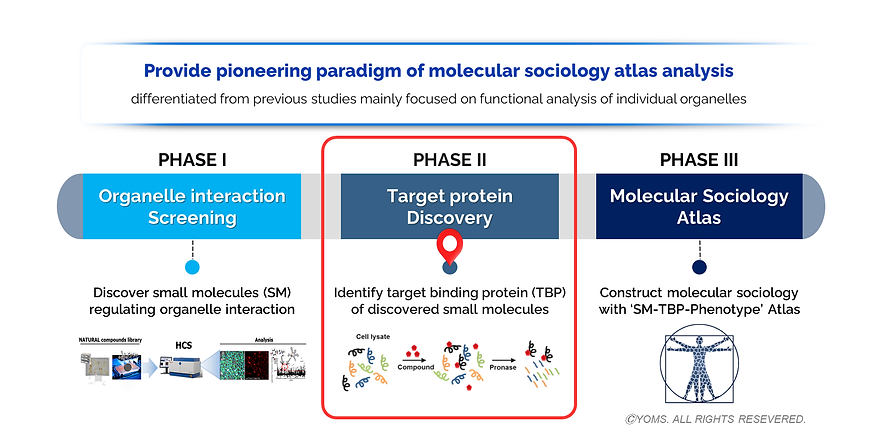
In the second phase of the study, we figured out how the compounds that regulate organelle interactions work and identified the target proteins of the compounds we discovered. This helps us understand the proteins involved and their functions. We created a targetome analysis platform by combining DARTS/CETSA and TMT-based LC-MS/MS technologies to identify non-labeled target proteins. We also confirmed that the compounds bind to their target proteins using biochemical tests.

Mitochondria
- Endoplasmic Reticulum
Mitochondria and the endoplasmic reticulum form a platform called the mitochondria-associated membrane (MAM), that facilitates communication between the two organelles. The MAM regulates several physiological processes, including calcium transport, lipid synthesis, autophagy, and ER stress.

Mitochondria
- Lysosome
Mitochondria and lysosomes which are central organelles of cellular metabolism interact each other to coordinate bidirectional organelle dynamics. In particular, lysosomes directly regulate mitochondrial fission through contact sites. Mitochondria-Lysosome contacts also mediate transport of metabolites, lipids, calcium and iron.

Mitochondria
- Peroxisome
Membrane contact sites of mitochondria and peroxisomes contribute to β-oxidation of FAs and has the ability to convey information to each other through the release of biological messengers such as ROS, lipids, or other metabolites. In addition, these organelles undergo intimate crosstalk during cellular redox metabolism.

Endoplasmic Reticulum
- Plasma membrane
The endoplasmic reticulum directly contacts the plasma membrane, play a significant role in regulating Ca2+ signaling and maintaining homeostasis. When Ca2+ levels decrease, the STIM protein interacts with ORAI, initiating Store-Operated Calcium Entry (SOCE). Tethering between the ER and plasma membrane also regulates ion and lipid transport, signal transduction, ER morphology and remodeling.

Endoplasmic Reticulum
- Lysosome
The direct membrane contact site between the Endoplasmic Reticulum (ER) and Lysosome facilitates transport of ions, cholesterol, lipids. It also influences lysosomal positioning, fission, and the dephosphorylation of lysosome membrane receptors by ER-based phosphatases.

Endoplasmic Reticulum
- Golgi Apparatus
The endoplasmic reticulum and Golgi interact and play roles in ceramide transport, subcellular localization, activation of lipid reverse exchange, and regulation of protein trafficking. However, many unknowns remain regarding their regulation and role in controlling key functions such as sorting and trafficking and their relevance in physiological and pathological conditions.
